| ID | Actions | Details | Feasibility | Impact | Effectiveness |
|---|---|---|---|---|---|
| 1.1 | Remove and decommission barriers | This action represents some projects that would be led by the planning team with conservation funds (e.g., orphaned barriers or those owned by individuals), while other restoration projects would be the responsibility of the barrier owner. Industry will have to be engaged to successfully implement this intervention. | Medium | Very high | Need more information |
| 1.2 | Upgrade and resize crossings | Examples include installing larger culverts, replacing closed- with open-bottom culverts, or upgrading from culverts to bridges. Important to engage with the agriculture community for some crossing upgrades. | Medium | Very high | Need more information |
| 1.3 | Install temporary mitigation | Examples may include installing fish ladders on barriers that cannot be rehabilitated; however, temporary mitigation does not replace the need for barrier rehabilitation and removal. There are specific cases where temporary fixes are appropriate, but we will focus on long-term solutions wherever possible. | High | High | Effective |
| 1.4 | Raise funds to rehabilitate barriers | See “Funding Sources” for more information. Consider inviting potential funders to a fundraising sub-committee. | High | Very high | Effective |
| 1.5 | Request regulatory action for non-compliant crossings | Request provincial and/or federal agencies to require that targeted, high-priority barriers be rehabilitated. This should be a last resort after working to engage barrier owners and ground-truthing the situation. It will be important to identify obstacles to applying compliance and enforcement measures in order to provide the appropriate information on these opportunities. For example, advocating for increased discretionary decisions to remove barriers to fish. One action could be to submit barrier assessment data to show proof that regulations are not being followed. | Very high | Medium | Need more information |
| 1.6 | Engage with CN to address their barriers | Build relationships with CN to open a two-way discussion on the scale, priority and impact to their business of barrier rehabilitation. Include the financial and ecological cost/benefits of rehabilitation options, with emphasis on the financial. This could start as a letter from both First Nations to show that each community, elected chief, and hereditary house sees this as an issue that needs to be resolved. | Very high | Medium | Need more information |
| 1.7 | Knowledge Gap: Continue updating the structure prioritization model | The model has been updated to reflect 2021 field assessments and intermediate barrier review. | Very high | Very high | Very effective |
| 1.8 | Knowledge Gap: Adapt the provincial fish passage framework to account for adult fish and low-flow conditions | Very high | Medium | Need more information | |
| 1.9 | Knowledge Gap: Assess barriers by applying adapted version of the provincial fish passage framework | The first three steps are, (1) barrier assessments, (2) habitat confirmations, and (3) rehabilitation designs. Barrier assessment data should be captured in the PSCIS database, which is available to all partners. 85 field assessments were performed in 2021. | Medium | High | Need more information |
Situation Analysis
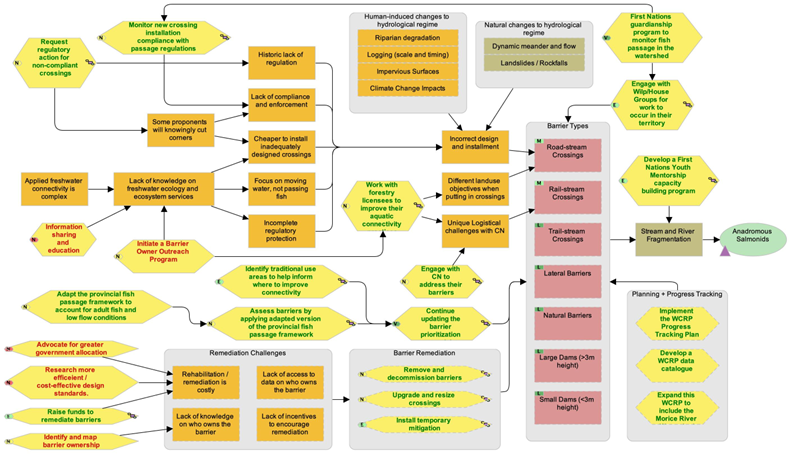
The following situation model was developed by the WCRP partnership to “map” the project context and brainstorm potential actions for implementation. Green text is used to identify actions that were selected for implementation (see ‘Strategies & Actions’), and red text is used to identify actions that the project team has decided to exclude from the current iteration of the plan, given that they were either outside of the project scope or were deemed to be ineffective by the planning team.
Strategies & Actions
The planning team identified four broad strategies to implement through this WCRP: 1) barrier rehabilitation, 2) barrier prevention, 3) strengthen Indigenous connections to land and water, and 4) planning and progress tracking. Individual actions were qualitatively evaluated based on the anticipated effect each action will have on realizing on-the-ground gains in connectivity. Effectiveness ratings are based on a combination of “Feasibility and”Impact”, Feasibility is defined as the degree to which the project team can implement the action within realistic constraints (financial, time, ethical, etc.) and Impact is the degree to which the action is likely to contribute to achieving one or more of the goals established in this plan.
Strategy 1: Barrier Rehabilitation
Strategy 2: Barrier Prevention
| ID | Actions | Details | Feasibility | Impact | Effectiveness |
|---|---|---|---|---|---|
| 2.1 | Work with forestry licensees to improve their aquatic connectivity practices | This should include encouraging better consultation before crossings are installed in the first place. | High | Medium | Need more information |
| 2.2 | Monitor new crossing installation compliance with regulations regarding fish passage | This action could be directly tied to action 3.3 - First Nations guardianship program. | Medium | Medium | Need more information |
Strategy 3: Strengthen Indigenous Connections to Land and Water
| ID | Actions | Details | Feasibility | Impact | Effectiveness |
|---|---|---|---|---|---|
| 3.1 | Develop a First Nations Youth Mentorship capacity building program | The program should emphasize: (1) working with First Nations youth, with emphasis on females, to help build capacity around waterway management, and (2) two-way mentorship to strengthen relationships and knowledge sharing with non-Indigenous youth (e.g., sharing knowledge on the importance of the land and the watershed according to Ayook, Adaakw, Inuk Nu'at'en, and Yintahk). | High | Very high | Effective |
| 3.2 | Engage with Wilp/Yikh for work to occur in their territory | Obtain permission from the appropriate Wilp/Yihk before conducting any work, including barrier assessments, habitat confirmations, and rehabilitation work. | Very high | High | Effective |
| 3.3 | First Nations guardianship program to monitor fish passage in the watershed | Very high | High | Effective | |
| 3.4 | Knowledge Gap: Identify traditional use areas to help inform where to improve connectivity | Used as decision support to choose which projects to proceed with. This information is proprietary, can only be used with permission, and should not be communicated externally. Proper protocols will be followed to ensure this knowledge and information is protected by the knowledge holders. | Very high | Very high | Very effective |
Strategy 4: Planning and Progress Tracking
| ID | Actions | Details |
|---|---|---|
| 4.1 | Implement the WCRP Progress Tracking Plan | The WCRP Progress Tracking Plan will help the team to determine whether we are achieving our goals and objectives |
| 4.2 | Develop a data catalogue on all current information related to aquatic connectivity in the Bulkley Watershed | |
| 4.3 | Explore expanding this WCRP to include the Morice River Watershed |
Theories of Change & Objectives
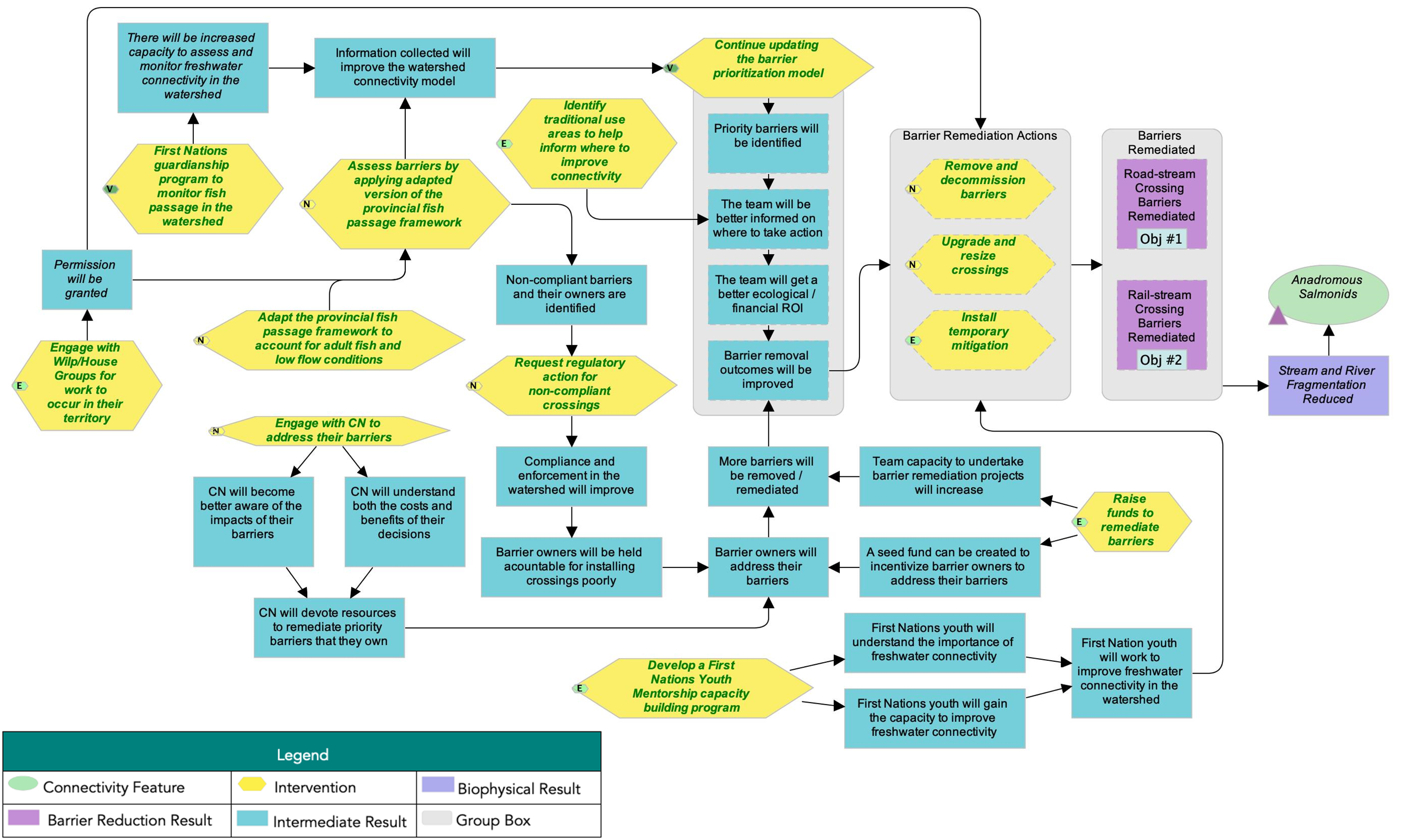
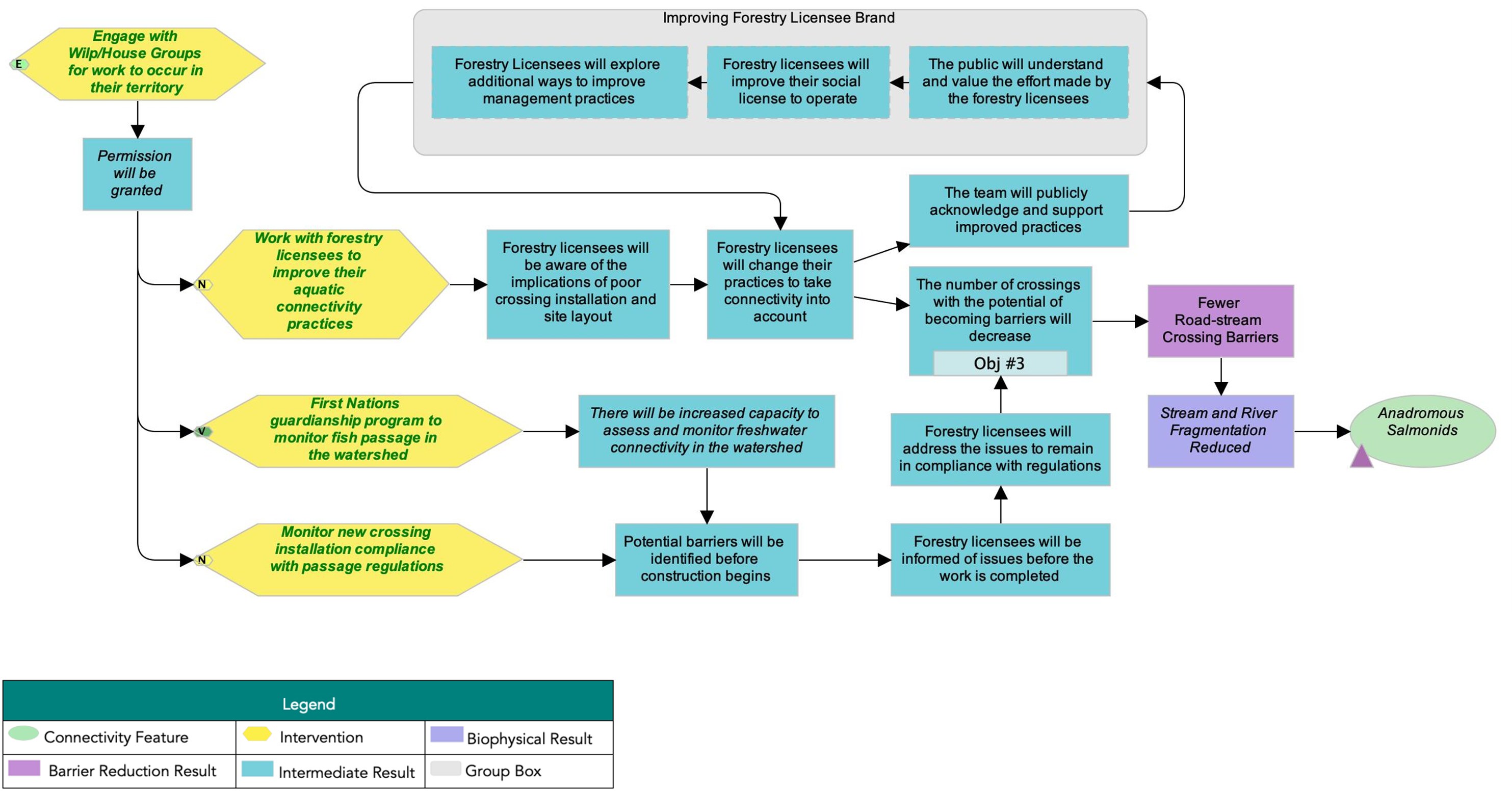
Theories of Change are explicit assumptions around how the identified actions will achieve gains in freshwater connectivity and contribute towards reaching the goals of the plan. To develop Theories of Change, the planning team developed explicit assumptions for each strategy which helped to clarify the rationale used for undertaking actions and provided an opportunity for feedback on invalid assumptions or missing opportunities. The Theories of Change are results oriented and clearly define the expected outcome. The following theory of change models were developed by the WCRP planning team to “map” the causal (“if-then”) progression of assumptions of how the actions within a strategy work together to achieve project goals.
Funding Sources
Funding Source | Spending Restrictions and Other Consideration |
|---|---|
Land Based Investment Strategy | Assessment and rehabilitation of fish passage using provincial strategic approach. Primarily for rehabilitation of Ministry-owned/orphaned barriers on forest service roads. |
Environmental Enhancement Fund | Fish and wildlife passage improvements and restoration at stream and animal crossings at MOTI roads including culvert retrofits and replacement to restore Pacific salmon and trout access, and wildlife tunnels. Primarily for crossings linked to highway infrastructure. |
Community Salmon Program | For projects supporting the protection, conservation and enhancement or rehabilitation of Pacific salmonids and their habitat. Funding for volunteer and not-for-profit community-based groups. Applicant must have a significant volunteer component to their group and to the project. Requires 50% match for funding (volunteer, in-kind, donation or other grants). |
Southern Boundary Restoration and Enhancement Fund | Supports 3 activities: (1) develop improved information for resource management; (2) Rehabilitate and restore marine and freshwater habitat; and (3) enhance wild stock production through low technology techniques. Emphasis for funding is on stocks of conservation concern, particularly those contributing to a fishery and stocks of bilateral fishery relevance. |
Habitat Conservation Trust Foundation Enhancement and Restoration Grants | Projects that focus on freshwater wild fish, native wildlife species and their habitats, have the potential to achieve a significant conservation outcome, while maintaining or enhancing opportunities for fishing, hunting, trapping, wildlife viewing and associated outdoor recreational activities. Primary focus is on provincially managed fisheries such as Steelhead and Westslope Cutthroat Trout. Requires 50% funding match. |
Environmental Damages Fund | Direct funds received from fines, court orders and voluntary payments to priority projects that will benefit Canada’s natural environment, under 4 categories of improvement (in order of preference): (1) restoration, (2) environmental quality improvement, (3) research and development, and (4) education and awareness. |
Habitat Stewardship Program for Aquatic Species at Risk | Program for non-profits, Indigenous governments, academic institutions for activities that align with recovery actions identified in SARA recovery documents and/or COSEWIC assessment documents. Project must address one or more of 3 broad categories: (1) Important habitat for aquatic species at risk is improved and/or managed to meet their recovery needs; (2) Threats to aquatic species at risk and/or their habitat are stopped, removed, and/or mitigated; (3) Collaboration and partnerships support the conservation and recovery of aquatic species at risk. Limited to at-risk species listed under COSEWIC and/or SARA as threatened, endangered or special concern. |
Canada Nature Fund for Aquatic Species at Risk | Funding program aimed at addressing priority threats for aquatic species at risk listed as endangered, threatened or Special Concern by COSEWIC, as they align with existing federal, provincial or other local recovery plans. Limited to species in the Columbia and Fraser basins in BC, among other priority areas across Canada. Focus on multi-year, multi-partner initiatives that apply an ecosystem or multi-species approach and create a legacy by enabling recovery actions that carry beyond the life of the funding program. Amounts from $100K-$1M available per year. |
BC Salmon Restoration and Innovation Fund | Funding for Indigenous enterprises, academia, industry associations, stewardship groups and commercial groups to support initiatives that support the protection and restoration of wild Pacific salmon and other BC fish stocks or ensure fish and seafood sector in BC is environmentally and economically sustainable. Five main priorities including species of concern rebuilding through habitat restoration with priority for projects that are part of a watershed-scale restoration plan/prioritization effort; build on successful previous restoration efforts; focus on critical habitat and/or the rehabilitation of natural ecosystem processes. |
Aboriginal Fund for Species at Risk | Program for Indigenous groups for activities that align with recovery actions identified in SARA recovery documents and/or COSEWIC assessment documents for species listed as Endangered, Threatened, or Special Concern by SARA or COSEWIC. Project must address one or more of 4 broad categories: (1) Habitat for species at risk is improved and/or managed to meet their recovery needs; (2) Threats to species at risk and/or their habitat are stopped, removed and/or mitigated; (3) Collaboration, information sharing and partnership between Indigenous communities, governments and organizations and other interested parties (e.g. federal/provincial/territorial governments, academia, industry, private sector) is enhanced; and (4) Capacity within Indigenous communities, to lead in the stewardship of species at risk and contribute to broader SARA implementation, is strengthened. |
Federal Gas Tax Fund - Community Works Fund | Funding available to local governments from federal gas tax, with funds to be allocated for a variety of municipal projects/initiatives, including local roads/bridges and disaster mitigation. |
Disaster Mitigation and Adaptation Fund | For those projects where flood risk is high: Funding available to local, regional and provincial governments, private sector, non-profit organizations, and Indigenous groups for projects aimed at reducing the socio-economic, environmental and cultural impacts triggered by natural hazards and extreme weather events and taking into consideration current and future impacts of climate change in communities and infrastructure at high risk. Includes both new construction of public infrastructure and modification/reinforcement of existing infrastructure. Projects must have a minimum of $20 M in eligible expenditures and can be bundled together. |
Community Gaming Grants | Funding for non-profit organizations (check funding program guidelines for specific eligibility requirements) for programs that help to protect and improve the environment by: (1) Conserving or revitalizing local ecosystems, (2) Reducing greenhouse gas emissions, (3) Providing community education or engagement opportunities related to the environment and agriculture or (4) Supporting the welfare of domestic animals and/or wildlife. Grants range from $100K-250K per year. |
Sitka Foundation | Funding for registered charities, universities, and government agencies (qualified Canadian organizations) for projects related to coastline and watershed conservation and climate change in 4 key areas: (1) land, water, and ocean conservation, (2) scientific research for nature and the environment, (3) public engagement around the importance of a healthy environment, (4) innovative conservation efforts in Canadian communities, at the local, provincial, and federal levels |
TULA Foundation | Supports various environmental programs of interest to the Foundation on a case-by-case basis. |
Vancouver Foundation | Granting agency for community, social and environmental initiatives for qualified Canadian organizations (charitable organizations, universities, government agencies). Granting programs change on an annual basis. |
BC Conservation Foundation Small Project Fund | Funding available to Non-profits, fish and wildlife clubs (sportsmen’s associations), businesses, local/regional governments, public organizations and First Nations for projects with demonstrated positive impact for fish, wildlife and habitat, including outreach programs. Preference given to projects where BCCF is not the sole funder. |
Real Estate Foundation of BC General Grants | Funding for First Nations, charities and societies, non-governmental organizations, universities and colleges, trade associations, local and regional governments, and social enterprises registered as C3s for sustainable land use and real estate practices in BC. Funds up to 50% of cash portion of a project. |